Work From Home As A Travel Agent Complete Guide Make Money Today!
Love To Travel? Need Extra Income? This Is It, Complete Step By Step Guide To Working From Home As A Travel Agent And Earning Money Today! Exact Steps You Need To Take To Sell Travel On Line, Working From The Comfort Of Your Own Home!
THROUGH THE EYES OF A TRAVELER
Ebooks On Mind Travel. Get your copy now. It is awesome!!!

Monday, March 31, 2014

Beyond The Sea


The living room of Brice Marden’s former home, now lived in by his daughters, with a dog sculpture by the artist Cathie Pilkington in front of the fireplace.

The sun-soaked island of Hydra has long inspired artists and intellectuals from Henry Miller to Leonard Cohen, and even today with the influx of art stars and yachting billionaires, its unspoiled charm remains intact.
I had only been on Hydra a few days last summer when an astonishing boat sailed into the harbor. Shaped like a stealth fighter and bright with cartoon colors, Guilty is the private yacht of the billionaire Greek art collector Dakis Joannou. Dakis, as the Hydriots call him, is a Cypriot and one of the most famous men in this part of the Aegean. Six years ago he opened an outpost of his Athens-based Deste Foundation for Contemporary Art in an old slaughterhouse on the island. That same year he had Jeff Koons design a paint scheme to decorate his yacht, which he sails into Hydra’s discreetly affluent harbor every summer.
Guilty is a splash of New York art-world luridness among the elegant masts and Aegean colors of the other yachts. It’s the way Dakis likes it. Strolling past the waterfront cafes with their upper-class English summer immigrants and the twee boutiques housed in old sponge factories, I made my way along the dock to meet him, wondering all the while what it was like to sleep and wake in a floating art gallery on the high seas.
In almost no time a carpet had been laid out at the foot of the gangplank glittering with the word “Guilty.” Guilty of what? a visitor is bound to ask himself. On board, the genial billionaire waved me up.
“I suppose,” he deadpanned, “you had no trouble finding me?”
“I’ve been coming here for years,” Dakis said as he pointed out the pair of tall harbor-front houses he owns. “Only 2,000 people live here year-round, but in the summer it’s quite a scene. It’s one of the most haunting of the Greek islands. Outside of this port, it is virtually wild.”
The yacht of billionaire art collector Dakis Joannou, for which he commissioned the artist Jeff Koons to paint the exterior, docked at Hydra’s port.
Photograph by Alexia Silvagni. Produced by Konstantin Kakanias.
The yacht of billionaire art collector Dakis Joannou, for which he commissioned the artist Jeff Koons to paint the exterior, docked at Hydra’s port.

The port is ringed by bare brown hills. Salt-white houses extend on either side of the harbor — that classic effect of Greek islands — and even there on the water I could hear the cicadas rasping in the pines. It made for a startling contrast with this art-filled yacht, in whose master bedroom a neon sign by Martin Creed above the bed spelled the word “Feelings.” The David Shrigley cartoons on the walls seemed to come from a different planet.
“I love Hydra,” Dakis said as we came back into the sunlight and the clatter of pack donkeys on the quays (there are no cars allowed on Hydra). “It’s one of those places — one of the magical places.”
Each June, Dakis invites a couple hundred of the world’s most famous artists, dealers and collectors to mingle and celebrate the opening of the annual summer exhibition at the Deste foundation. One year, to open their show, Matthew Barney and Elizabeth Peyton orchestrated a dawn “procession” with a variety of animals and a large dogfish laid on a casket.

Wanderlust | Madurai, India, Where Time Stands Still


Though it’s home to more than a million people, Madurai, the second-largest city in the South Indian state of Tamil Nadu, remains a paradigmatic temple town. Around its ragged edges, Madurai looks much like any other medium-sized Indian city, with its clusters of concrete buildings and traffic-choked streets. But at its center – an elegant arrangement of concentric ring roads surrounding the labyrinthine, 17-acre compound of the Meenakshi Temple, among the holiest in South India – the city feels timeless. You come here not to experience the much-touted New India but the India that has endured for centuries.
For 2,500 years, Madurai has served as the wellspring of culture in Tamil Nadu, arguably the most traditional state in India. A 15-minute walk around the Meenakshi Temple compound in the late afternoon, as the gates swing open for the evening prayers, can serve as a cultural fly-by. Devotees line up beneath the soaring centuries-old ceremonial gates, or goppurams; shopkeepers step onto the pavements, hawking brass vessels, coconuts and marigold garlands; tailors sell the local cottons that brought the city prosperity under the Raj. Inside is a riot of sensory information, from the thousands of brightly painted statues crowding onto each goppuram to the hall-of-mirrors arcades to the monolithic statues of deities that occupy every open niche. The sounds of voices and bells, the singular cacophony of an active Hindu temple, are everywhere.
The Heritage Madurai, a genteel retreat at the edge of town, is an ideal base from which to explore the temple and the rest of the city. In 1972, the legendary Sri Lankan architect Geoffrey Bawa designed the main structures — a series of deeply shaded pavilions and verandas in wood, rough-hewn stone and terra cotta — as the Madurai Club. It reopened in 2009 as the city’s only boutique hotel. Here, a few must-visit destinations nearby.
With 14 ceremonial towers covered in a proliferation of candy-colored statuary, the Meenakshi Temple is one of the most important Hindu devotional centers in India, and Madurai’s pièce de résistance. Hire one of the official guides patrolling the grounds and give yourself at least an hour to see the whole compound.
Open for morning and evening prayers, 5 a.m. – 12:30 p.m., 4-10 p.m.

Textile Shops
Madurai’s modern fortunes were made in its mills. There are a great many textile and tailoring outlets around the temple, but the two most reputable are Co-optex (20 South Chitrai Street, 011-91-452-234-4047), a government-run weavers’ cooperative, andHajeemoosa (18 East Chitrai Street, 011-91-452-262-2118), whose knowledgeable owner Ismail Omar can explain some of the dyeing and weaving techniques.

Flower Market
The largest in South India, it’s best seen early in the morning, when the vendors first arrive from the countryside to sell bushels of roses, cockscombs, marigolds, lotuses and Madurai’s famous jasmine. The Heritage can organize trips to the jasmine fields outside town when the flowers are in season. The vegetable market down the road is also worth a visit.

This huge, no-frills canteen is a popular place to experience an unlimited South Indianthali, a style of eating that involves a wide array of vegetarian dishes served, traditionally, on a plantain leaf. Speak up when you’ve had enough, or they’ll just keep serving.
78/3-A.1 Gowri Plaza, Bypass Road, 011-91-452-435-2828.

Local Crafts
As a center for traditional Tamil culture, Madurai is known for woodcarving, stonework and bronzes. The Heritage can help set up appointments to watch craftsmen at work with any of these media, or, with advance notice, arrange for a visit from Muthulakshmana Rao, whose family has crafted leather shadow-puppets for five generations.

Thirumalai Nayakar Mahal
The restoration of this 18th-century palace, erected under the Hindu Nayak Dynasty, is patchy (too little here, too much there), but the scale of the structure is undeniably impressive and much of the detail work stunningly intricate. 9 a.m – 1 p.m., 2-5 p.m.

The Beautiful of Miami


A tranquil view from the Metropolitan by Como hotel in Miami Beach.

A tranquil view from the Metropolitan by Como hotel in Miami Beach.


It may be one of the world’s most glamorous playgrounds, but Miami Beach comes in more flavors than just plain party. Far from the madding crowds on the Lincoln Road Mall and Ocean Drive and the hubbub of this week’s Winter Music Conference, there’s another Miami Beach, one that’s quiet, chic and even subtle.
A peaceful hotel
The newest address for a different take on Florida’s most fabulous sandbar is theMetropolitan by Como (2445 Collins Avenue, Miami Beach; 305-695-3600), the just-opened 74-room renovation of the circa-1926 Traymore Hotel on Collins Avenue. Unlike most hotels in Miami Beach, this Art Deco beauty is so small and discreet, it’s easy to miss along the skyscraper-lined seafront, but at night, it shows off its design credentials with an original neon sign that still says Traymore, in spite of its recent rebranding as the first U.S. property of the Singapore-based hotelier Christina Ong’s Como Hotel group. The Italian designer Paola Navone did the serene seashell-like interiors of the hotel in a scheme that respects its good bones but doesn’t pastiche them, a look that will doubtless be popular with visitors to the Paris-based design show Maison & Objet when it stages its first show in Miami Beach in May of 2015. There’s rooftop hydrotherapy, a heated swimming pool (without a disco soundtrack) in a beautifully landscaped garden, a spa and a full-service private beach. With a young staff that is smart, friendly and attitude-free, the Metropolitan by Como might also have the best service of any hotel in Miami Beach.
The roof of the Metropolitan by Como features a party-free pool.

The roof of the Metropolitan by Como features a party-free pool.


Morning delights
The chef Jonathan Lane does excellent modern American cooking, including a lot of fresh Florida seafood, at the hotel’s beautifully lit, refreshingly concept-free Traymorerestaurant. The baked eggs with black beans and Cuban sausage at breakfast are a good reason to get out of bed in the morning. Or pick up a paper and head to the mellow and reasonably priced French-owned A la Folie Café (A La Folie Café, 516 Española Way, Miami Beach; 305-538-4484) on charming Española Way for good croissants and coffee.
French invasion
The easygoing Semilla (Semilla Eatery & Bar, 1328-1330 Alton Road, Miami Beach; 786-955-7580), another place with a French touch, has become popular with the local European expat crowd since it opened a few months ago. The chef-owner Frederic Joulin’s small-plates menu is terrific, too, including braised beef short-rib pot stickers with green curry, Vermont goat cheese with bacon croquettas and lobster mango remoulade, dishes that pair perfectly with Jean-Luc Colombo’s easy-drinking Coteaux d’Aix rosé, a bargain at $32.


At Semilla, dessert macarons resemble sliders.


Lunch, the old-fashioned way
For a the-way-we-were moment and great deli sandwiches to take to the beach, head up to Goldstein’s Prime delicatessen (Goldstein’s Prime, 7419 Collins Avenue, Miami Beach; 305-865-4981) in North Miami Beach. The founder Joe Goldstein, a former Long Islander who runs the last kosher deli in town with his son Brian, is the kind of guy who’ll give you a quarter for the parking meter outside even before you’ve placed your order. Ringing up the pastrami, he volunteers that he doesn’t get to speak his ancestral Hungarian very often anymore. “Now what I need is Spanish,” he says with a shrug and a grin. “But I like the change, and Miami Beach, it’s a beautiful place to live.”

Sunday, March 23, 2014

Best Beaches On Earth by Travel & Leisure

Hye, I found this article for Travel and Leisure magazine and this beautiful beaches stumbled upon me. I really want to spend my vacation here enjoying this beautiful clear water, it's so fresh!.
by istalk photo
There are an infinite number of beaches around the globe, but this year, to determine the best sandy spots, Travel + Leisure launched our first annual Best Beaches Survey—and asked savvy travelers to reveal their favorite places.
The list started with 54 famous beaches, grouped by type, and voters ranked the idylls they love. One point came across loud and clear: you don’t have to travel far to experience a spectacular beach. In fact, U.S. beaches won out in almost every category, from seclusion to people-watching. (You’ll have to travel the distance to reach the ultimate destination for wildlife spotting: Bahia Gardner, in the Galápagos Islands.)
Every traveler knows that the perfect family-friendly beach has to deliver more than just a picturesque scene. Beaches with wide sand, calm waves, and easily accessible amenities are what parents need when the little ones are in tow. Take Seaside Beach, FL, for instance, known for its emerald water and cruiser bike–filled streets.
Further afield, in the Caribbean, all-inclusive hotels and endless kid-friendly activities—snorkeling, bodyboarding, and sea kayaking—are some of the reasons that parents of kids and teens love Seven Mile Beach, in the Cayman Islands.  
Those in search of an off-the-grid stretch of sand will want to note the beaches that T+L readers deemed best for seclusion, starting with Polihale Beach, Kauai. Its wild, seven-mile shoreline is accessible only by old farm roads. But voters also gave a nod to One Foot Island Beach in the South Pacific’s Cook Islands. Perhaps this beach is so alluring because the visit is inherently ephemeral: flip-flop-wearing travelers are not able to spend the night. Instead, drumbeats at dusk signal the last boat to nearby Aitutaki island, where a small airport welcomes four flights a day from Raratonga.
Read on for the top 30 beautiful beaches, both familiar and lesser known.

Most Wanted Place I want To Visit

This is what I wanted to do most in my life. Let have an idea how this Mongolia attracts you personally. I found this article at http://www.travelandleisure.com/articles/inland-empire

Emerging from the long shadow of Soviet Communism, Mongolia—with its stark, ravishing landscapes and resurgent Buddhist traditions—is looking west for its future.

Mongolia Map
Arriving in Mongolia on the Trans-Siberian Express from Beijing, I wondered where everyone was. In China, there had been crowds everywhere, the dense human mass overwhelming even to someone from India. But just miles after we crossed the border with China, an eerie void defined Mongolia.
This shouldn’t have been so strange—after all, the Gobi Desert covers much of southern Mongolia. But when I thought of Mongolia I pictured the multitudes of horsemen that swept across Central Asia and Russia in the 13th century, all the way to Central Europe, creating the greatest land empire the world has ever seen.
All through that cold morning, pastureland rolled past my train window. I saw an occasional ger—the white circular tent that is the Mongolian version of the Central Asian yurt—and horses accompanied by a cowboy with an uurga, the Mongolian lasso. And then there was emptiness for hours on end.
The blank landscape seemed to have subdued the Chinese attendants in my coach. Huddled with their pals over beers in the dining car, as the Trans-Siberian Express began its long journey from Beijing to Siberia via the Gobi Desert, they had barely glanced up as I stumbled through my phrasebook-aided request for hot water. In the bright Mongolian morning, they seemed withdrawn.
The Russian couple in the compartment next to mine also looked sullen. They’d had a terrible night. At the border crossing the night before, the Mongolian immigration officer had told them that their visas had expired and had threatened to throw them off the train into what seemed, literally, the middle of nowhere. Sitting in my compartment, I had heard their tearful pleadings. Then, even the Chinese attendants looked sympathetic.
It had finally been sorted out, after a delay of almost two hours. The Mongolian officer relented and gave new visas to the Russians. He may have been bluffing after all. The Chinese attendants looked relieved, the Russians grateful, if worn out by their ordeal.
It was an odd scene—the assertive Mongolians, the subdued Chinese, and the terrified Russians. It hinted at great historical shifts and ironies: the hierarchies of the Cold War, when Mongolia was a satellite state of the Soviet Union, had been overturned. But it was after a few days in Mongolia, with a greater understanding of what it meant to be a modern Mongolian, living in a country sandwiched between Russia and China, that the fuller meaning of what I had witnessed would become clear.
Though surrounded by giants, Mongolia itself is no slouch. It is twice the size of Texas, but with a population of fewer than 3 million people—it has the lowest population density in the world. More than a third of Mongolians reside in the capital city, Ulaanbaatar, which lies on a plateau surrounded by high mountains. It was only late September when I arrived, but it felt like December in the Himalayas, the air full of the smell of snow. Temperatures can drop by 55 degrees in a single day.
I would soon leave Ulaanbaatar for the northern borderlands, where the Mongolian steppes yield to the Siberian taiga, into a purer void than I had seen from my train. But the city, I discovered, holds plenty of surprises for the flaneur. I had imagined something more Chinese, or Asian: a staging-post or a market town, with nomads on horseback and crimson-robed monks in its narrow alleys. In 1924 Mongolia had been only the second country in the world after the Soviet Union to go Communist. If I was unprepared for the Soviet, faux-European architecture of Ulaanbaatar, and the signs in Cyrillic everywhere, I was even less ready for the gridlock traffic on broad avenues, the new cafés, beer bars, beauty salons, and discos packed with both expatriates and trendy Mongolian youth, or the cranes everywhere, one of them constructing Mongolia’s first five-star hotel. Being a vegetarian, I had prepared for the austerity of Mongolia, stocking up on processed cheese and crackers in Beijing. I realized I had wasted my time when I found myself on Peace Avenue, the city’s main thoroughfare, surrounded by multiethnic cuisine and fusion restaurants and department stores and supermarkets.

Tuesday, March 18, 2014

Summer in South Korea In The Making

Hi everyone. I have just completed my itinerary for the Korea trip in June 2014 and obviously I just can't wait to fly to the moon!. I have read, surfed a lots Korea materials just to ensure this incoming trip become memorable and remarkable ones. I did blog hopping and take almost everything into consideration so that I could avoid any see-able hiccups and I hope the plans can be expedite well.

Yes, this is will be my very first time to Korea. Since my younger sister is now studying in Incheon, I hope the tasks that I gave her will smooth-en our journey later on. Again, as Jeju is the most awaited destination to be visited, I share with you guys the 15 attractions in Jeju by TommyOoi (just click here peeps)

1. Seongsan Ilchulbong Peak

Seongsan Ilchulbong Peak (182 meters high) rose from the sea in a series of volcanic eruptions beginning over 100,000 years ago.
The site resembles an old fortress on a coastal cliff and was originally a volcanic island but was later connected as sand and gravel accumulated in between.
The sunrise seen from the peak is considered one of the most fascinating scenic views in Jeju.

Admission Fees

Age 24-64: 2,000 won / Age 7-23: 1,000 won / 65 and over, 6 and under: Free

Getting there

By Bus
1. From Jeju-si
Jeju Intercity Bus Terminal -> Seongsan Ilchulbong Peak (1 hour 30 min ride/ 20 min interval)
2. From Seogwipo
Seogwipo Intercity Bus Terminal -> Seongsan Ilchulbong Peak (1 hour 30 min ride/ 20 min interval)

2. Manjanggul Cave

Manjanggul Cave is the longest lava tube in the world. It is 5 meters wide, between 5 to 10 meters high and is over 13 km long.
The lava tube, which formed about 2.5 million years ago, has been well preserved, revealing a splendid interior that is out of this world. Only one kilometer of its total length is open to tourists.

Admission Fees

Adults – 2,000 won / Youth -  1,000 won / Children – 1,000 won
Free – Senior citizens, disabled visitors

Getting there

Bus
From Jeju-si
Jeju Bus Terminal, take the Donghoe Line Intercity Bus to get off at the parking lot near Manjanggul Cave Entrance. (Takes approximately 30 minutes.) At the parking lot, take a town bus bound for Manjanggul or a taxi.
From Seogwipo
Seogwipo Intercity Bus Terminal, take the Donghoe Line Intercity Bus to get off at the parking lot near Manjanggul Cave Entrance. (First Bus: 5:50 a.m. / Last Bus: 8:00 p.m. / 20 Min. Intervals / Takes approximately 1 hour and 30 minutes.)

Tommy Ooi’s Traveling Tips

After reaching Manjanggul bus station, take a taxi from main road to Manjanggul Cave as it is NOT WITHIN WALKING DISTANCE from main road, unless you are up to a 45 minutes walk challenge.
Read My Blog Post : Manjanggul Cave

3. Cheonjiyeon Falls

Cheonjiyeon Falls create a splendid view of water falling from a steep cliff with a sound that drowns out all others.
Cheonjiyeon, meaning “God’s pond,” derives its name from the legend that the seven fairies serving the King of Heaven came down to the pond on stairs of cloud and bathed in its clean waters.
The waterfall is 22m high, 12m wide and 20m in depth. The clear and deep water of Cheonjiyeon Falls is renowned as a habitat for Mutae eels. Also, the annual Seven Fairies Festival is held every May.

Admission Fees

Adult ( Above 24 Years Old ): 2,000 won / Youth ( 15 – 24 ): 1,000 won / Child ( 7-14 ): 1,000 won

Getting there

From Seogwipo – Take a taxi as it is more convenient.
Read My Blog Post : Cheonjiyeon Falls

4. Hallasan Mountain

Situated in the heart of Jeju Island, Mount Hallasan (1,950 meters) is the highest mountain in Korea and a dormant basalt volcano.
About 360 parasitic cones, or oreum in the Jeju dialect, are found on the volcano’s flanks, creating a remarkable landscape. On top of the mountain is a crater lake called Baengnokdam, which is 3 kilometers in circumference and 500 meters in diameter.
The landscape is beautiful throughout the year and a diverse and rare ecosystem can be found at different altitudes. As such, Mount Hallasan is a Natural Conservation Area.

Admission Fees

Adults: 1,600 won / Youths: 600 won / Children: 300 won

Getting there

Bus
From Jeju-Si
From Jeju Intercity Bus Terminal, take an intercity bus bound for Seongpanak (first bus 6:00 / last bus 21:30 / 10 min interval / 35 min ride / 1,700 won). Get off at the entrance Seongpanak.

5. Teddy Bear Museum

If you love Teddy Bears, then this is a MUST VISIT place. The Teddy Bear Museum lives up to its name, boasting quite an impressive variety that have been loved for more than a hundred years the world over.
There are two galleries that boast teddy bears from various countries. You can also enjoy yourself at the museum shop, café, restaurant or the outdoor park where you can view the spectacular Jungmun Sea.

Admission Fees

Adult : 7,000 won / Youth : 6,000 won / Child, Senior & Disabled visitors : 5,000 won

Getting there

Bus – Take Airport Limousine Bus & stop at Jungmun Tourist Resort Complex
Read My Blog Post : Teddy Bear Museum

6. Yeomiji Botanic Garden

Yeomiji Botanical Garden at Jungmun Tourist Complex is the largest botanical garden in Asia, the magnificent glass Yeomiji Conservatory has collected and displayed 1,200 species of subtropical and tropical plants.
Yeomiji is a Chinese word consisting of three letters with “yeo” meaning “such,” “mi” “beauty” and “ji” “land,” which combines to mean a “garden paradise”.
In Yeomiji Garden, there are several greenhouses with different theme -  flower garden, an aquatic plant garden, cactus and succulents garden,  jungle garden & tropical fruits garden.

Admission Fees

Adult – KRW7,000

Getting there

Bus – Take Airport Limousine Bus & stop at Jungmun Tourist Resort Complex
Read My Blog Post : Yeomiji Botanical Garden

7. Jeongbang Falls

Jeongbang Falls (정방폭포) is only water fall in Asia that falls directly into the ocean.
On the wall of the water fall, there is an inscription written “Seobulgwacha”, referring to Seobul passing by this place. Seobul was a servant of the Chinese Emperor Jin (BC 259~210) who was ordered by the Emperor to find the substance that would make him immortal.
Seogwipo is also said to have gotten its name to mean Seobul headed back west.

Admission Fees

Adults 2,000 won / Children 1,000 won

Getting there

From Seogwipo – Take a Taxi as it is much more convenient.
Read My Blog Post : Jeongbang Falls

8. Yakcheonsa Temple

Yakcheonsa, which means ‘temple where medicinal water flows,’ was built in 1981 by Buddhist monk Hae-in. He founded the temple after visiting the small cottage that was originally found on the site.
Visitors to Yakcheonsa will have plenty to explore. The main temple has multiple floors and balconies that overlook a beautiful three-meter-tall Buddha, contained in a large prayer hall. The main temple is filled with murals of Buddhist legends.

Admission Fees

FREE

Getting there

Bus – Take Airport Limousine Bus & stop at Yakcheonsa Bus Station
Read My Blog Post : Yakcheonsa Temple

9. Jusangjeolli Cliffs

Jusangjeolli Cliffs refer to the set of blackish, rock pillars of rectangular or hexagonal shapes on the east coast of Jungmun Tourist Resort. As if carved by stonemasons, the pillars are evidence of nature’s awesome power.
Most commonly expressed as vertical columnar jointing, the formations are created via sudden cooling of lava that shrinks in mass. The sight of waves crashing against the columns is both serene and beautiful.
On days with rough weather, waves can rise as high as 20 meters.

Admission Fees

Adult 2,000 won / Youth and Child 1,000 won

Getting there

Bus - Take Airport Limousine Bus & stop at International Convention Center. Keep walking to the right direction(5 min walk).

10. Cheonjeyeon Falls

Cheonjeyeon Falls (천제연폭포), named ‘The pond of God’, consists of 3 parts. Around the falls, a variety of plant life thrives, such as the rare ‘solipnan’ reeds. To the east, there is a cave where cold water pours from the ceiling to create a waterfall.

Admission Fees

Adults 2,500 won / Youths 1,370 won / Children 1,370 won

Getting there

Bus – Take Airport Limousine Bus & stop at Jungmun Tourist Resort Complex
Read My Blog Post : Cheonjeyeon Falls

11. Yongduam Rock

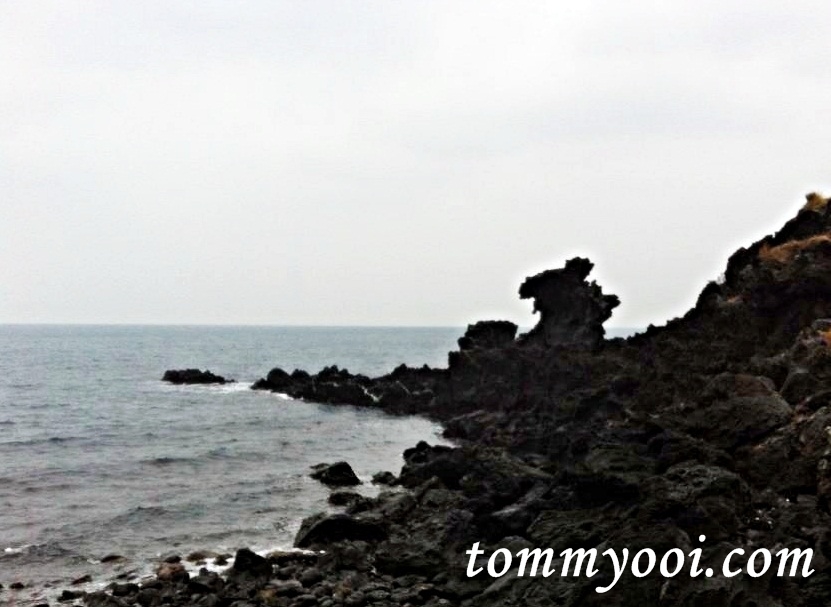
Situated to the north of Jeju City, Yongduam was created by strong winds and waves over thousands of years. However, there are plenty of other stories of how it came to be.
One legend has it that a dragon stealing precious jade from Mt. Halla was shot down by an arrow from the mountain deity. When he fell down on Yongduam, his body immediately sank into the ocean and his head rapidly froze looking at the sky.
Another legend has it that a white horse, who dreamed of being a dragon and ascending to the sky, came to be caught by a soldier and froze into the rock.

Admission Fees

FREE

Getting there

From Jeju Airport
Bus – take any airport bus except No. 200,300 and get off at Yongdam 2-dong Office. Walk 15 min.
Taxi – Approx 15 min (about 4,000 won).

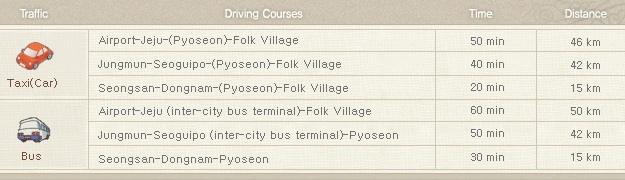
12. Jeju Folk Village Museum

With a total of 117 houses and facilities, Jeju Folk Village Museum has restored the scenes of the village to that of the 1890’s. Among them are Mountain Village, Hill-Country Village, Fishing Village and Shamanism Village.
On land of more than 40 acres it has been reconstructed following long-term research and analysis of experts. Some of the extensive range of folk items on display are 1,627 woodenware, 1,046 bamboo ware, 1,699 earthenware, 1,544 porcelain ware, 765 wax candles, 921 ironware and 579 other items.
The Jeju Folk Village Museum is the island’s main tourist attraction where customs of the old days can be explored.

Admission Fees

Adult : 7,000 won / Youth : 4,500 won / Child : 3,500 won

Getting there
13. Seonimgyo Bridge

Seonimgyo Bridge is an arch bridge on Jeju Island  over Cheonjeyeon Waterfall that has seven nymphs carved on both sides.
The bridge is also called Chilseonyeogyo (칠선녀교) or Seven Nymphs Bridge.
The nymphs symbolize the Korean legend of the descent of seven beautiful nymphs from heaven at night. Seonimgyo Bridge is the first arch bridge or Ojakgyo  (오작교) design in the region.

Admission Fees

Adult – 2,500 won

Getting there

Bus – Take Airport Limousine Bus & stop at Jungmun Tourist Resort Complex
Read My Blog Post : Seonimgyo Bridge

14. Jungmun Beach

Jungmun Beach (중문해수욕장) has a sandy shore so fine that it is called Jinmosal. The white sand beach is 560m long and the water has an average depth of 1.2m.
Different shades of black, red, and grey are beautifully mixed into the white sand of the beach. This helps to accentuate Jeju-do Island’s black Hyeonmuam stones. To the right side of the beach is a natural sea cave called Haesikgul Cave.

Admission Fees

FREE

Getting there

Bus – Take Airport Limousine Bus & stop at Jungmun Tourist Resort Complex. Then take a taxi to Jungmun Beach ( 5 mins ride ).
Read My Blog Post : Jungmun Beach

15. Loveland

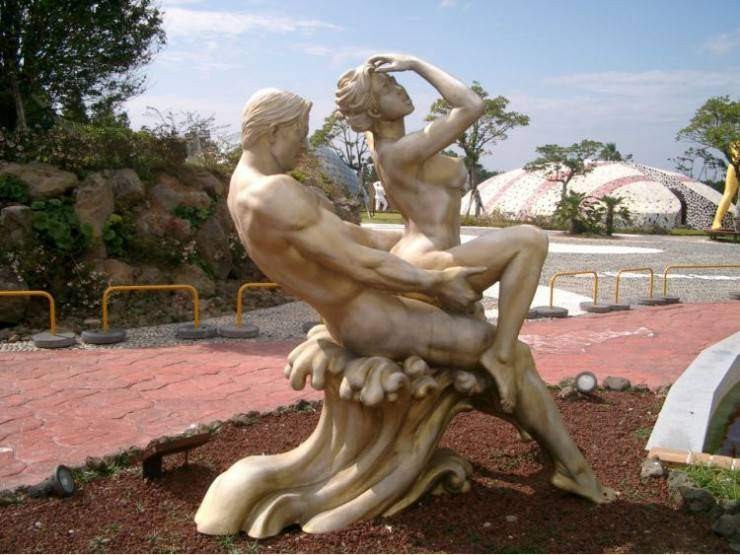
Jeju Loveland (제주러브랜드) (also known as Love Land) is an outdoor sculpture park which opened in 2004 on Jeju Island in South Korea.
The park is focused on a theme of sex, running sex education films, and featuring 140 sculptures representing humans in various sexual positions.
It also has other elements such as large phallus statues, stone labia, and hands-on exhibits such as a “masturbation-cycle.” The park’s website describes the location as, “a place where love oriented art and eroticism meet.”

Operation Hours

9am to midnight

Admission Fees

Adult – 7,000 won

Getting there

Taxi - Take a taxi from Jeju City